



TECHNIQUE
DHI Hair Transplant
In shortDHI stands for Direct Hair Implantation. Grafts are taken the same way as in FUE, but instead of opening a channel first and placing a graft into it afterwards, an implanter pen, the Choi pen, opens and places in one movement. That single difference is why DHI suits densifying between hair you still have, and why it can often be done without shaving.
Key facts
- Technique
- Direct Hair Implantation
- Instrument
- Implanter (Choi) pen
- Pen tip diameter
- 0.8 – 1.2 mm
- Needle gauge
- 21G × ½
- Extraction punch
- 0.6 – 0.8 mm
- Grafts per session
- 1,500–2,500
- Shaving
- Often not required
- Best at
- Hairline · densifying between existing hair
- Session length
- 6–8 hours, single day
- Carried out by
- Our surgeons, in our Istanbul clinics
DHI
What Direct Hair Implantation is
DHI is a form of FUE, not a different operation. Your follicles are still taken one by one from the back and sides of the head with a 0.6–0.8 mm micropunch. What changes is the way they go back in.
In Sapphire FUE the channels are opened first with a blade and the grafts are placed into them afterwards, in two separate stages. In DHI an implanter pen holds the graft and, in a single movement, makes the opening and releases the graft into it. No channel is cut in advance.
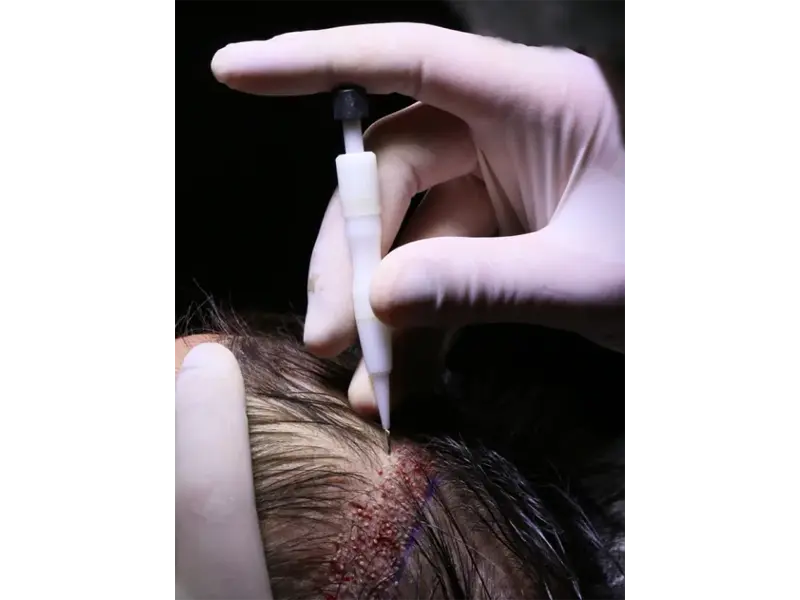
The instrument
The Choi pen, in specifics
The pen works rather like a click pen. A hollow needle at the tip holds the graft; a plunger pushes it out as the needle enters the scalp. The graft never sits waiting in an open channel, which is the practical point of the whole technique.
| Item | Value |
|---|---|
| Pen tip diameter | 0.8 – 1.2 mm |
| Needle gauge and length | 21G × ½ |
| Extraction punch | 0.6 – 0.8 mm |
| Grafts per session | 1,500–2,500 |
| Session length | 6–8 hours, single day |
| Anaesthesia | Local |
Pen tips come in a range of diameters because hair does not. A tip is selected against the thickness of your grafts: too narrow and the graft is crushed on the way through, too wide and the opening is larger than it needs to be. Several pens are usually loaded and rotated during the session so that placement is continuous.
Why it matters
What the one-step placement buys you
- Existing hair is not cut. Opening channels with a blade between hairs you still have risks catching them. The pen enters where the operator places it, which is why DHI is the technique of choice for densifying a thinning area rather than rebuilding a bald one.
- Often no shave. Because no channels are cut in advance, the work can frequently be done in unshaven or partially shaved hair. For many people this is the deciding factor.
- Shorter time outside the body. The graft goes from the storage solution straight into the scalp rather than waiting for a prepared channel.
- Angle control in the hairline. A very flat angle at the front edge is what makes a hairline read as natural rather than planted.
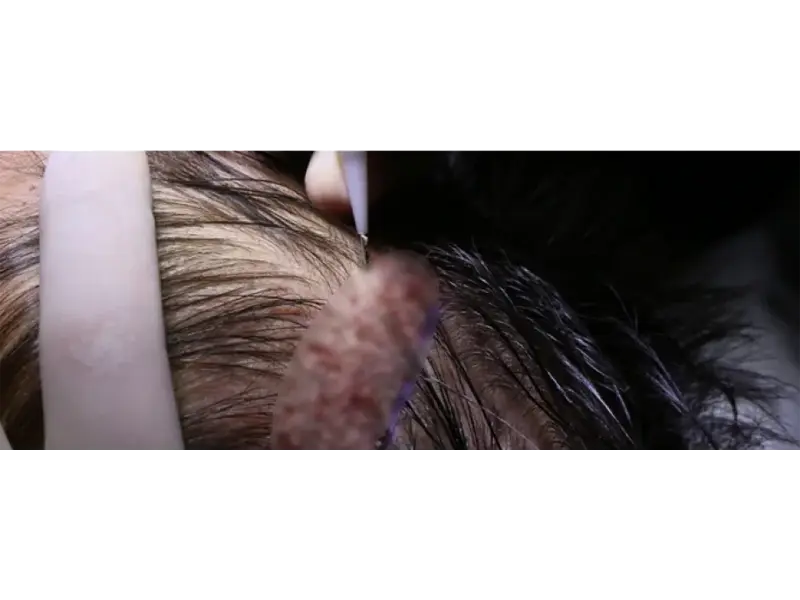
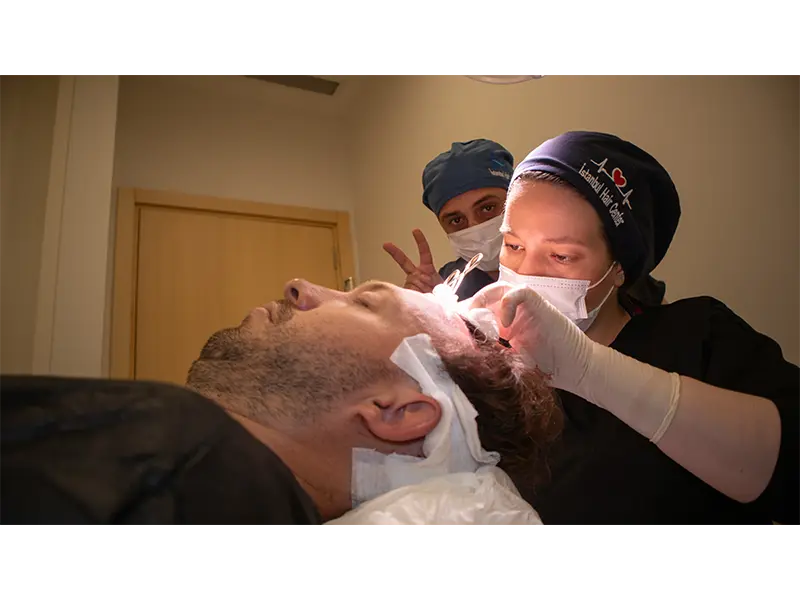
Placement at the hairline, and the operating environment at our clinic.
Free assessment
Is DHI the right technique for you?
That depends on your donor area and on what is still growing in the recipient area. Neither of which can be settled from a web page. Send four photographs and you will receive your donor capacity, an estimated graft count, the technique that suits you and an itemised written quotation.
Free pre-analysis
Start your personal assessment
Leave your number and our coordination desk will call you back, usually the same day.
Suitability
Where DHI fits, and where it does not
Suits
- Densifying between hair you still have
- The frontal hairline, where angle control matters most
- Wanting to avoid shaving, or shaving only the donor area
- Smaller, well-defined areas rather than whole-scalp coverage
Suits less well
- A large bald area needing maximum coverage in one session
- A graft count that would make an unshaven session unrealistic
- A budget-driven choice, placement is slower per graft
- A donor area that has itself thinned diffusely
For a large continuous area in a single session, Sapphire FUE is usually indicated instead. The two are compared side by side on the treatments page. Note there that the target density, the session length and the time to a final result are the same for both.
Recovery
Recovery and result
| Period | What happens |
|---|---|
| Days 1–3 | Swelling and redness. The first wash is done with you before you fly home. |
| Days 4–10 | Crusts form and come away with the prescribed washing routine. Do not pick them off. |
| Weeks 2–8 | The transplanted hairs shed. This is expected. The follicle stays; the shaft is what falls out. |
| Months 3–4 | New growth starts, fine and uneven at first. |
| Months 6–9 | Density builds and the result starts to read as yours. |
| Months 12–18 | The final result. Judging it before month twelve is judging it too early. |
The timeline does not change with the technique. Anyone offering DHI on the promise of a faster or denser result is selling something the technique does not do. What it changes is how the grafts go in, not how they grow.
Costs are on the cost page; the most common questions are answered on the FAQ page.
Frequently asked questions
Is DHI better than Sapphire FUE?
Neither is better; they answer different questions. DHI places grafts directly with an implanter pen, which suits densifying between existing hair and working without shaving. Sapphire FUE opens channels first, which suits covering a large continuous area in one session. Density, session length and time to the final result are the same for both.
Can DHI be done without shaving my head?
Often, yes. This is one of the main reasons people choose it, since no channels are cut in advance. Whether it is realistic for your graft count is a clinical judgement made after your donor area is examined.
How many grafts can be placed with DHI in one session?
Typically 1,500–2,500. Placement is slower per graft than in Sapphire FUE, which is the trade-off for the one-step technique. If you need a larger area covered in a single session, Sapphire FUE is usually the better fit.
What is a Choi pen?
The implanter pen used in DHI. A hollow 21G × ½ needle at the tip holds the graft and a plunger releases it as the needle enters the scalp. Tip diameters run 0.8–1.2 mm and are selected against the thickness of your grafts.
Is “Choi pen method” a different technique from DHI?
No. One is the name of the technique, the other the name of the instrument it uses. They are frequently marketed as though they were two procedures.
Does DHI work on curly or fine hair?
Pen tips are made in a range of diameters precisely because hair varies, and the tip is chosen against your graft thickness. Whether the technique suits your hair type is assessed before the plan is fixed.
Is DHI more expensive?
Packages run €2,000 – €3,000 and are priced per package rather than per graft. What moves the figure is the technique, the accommodation, the transfers and the scope. The cost page sets it out.
Will the transplanted hair fall out?
The shafts shed between weeks 2 and 8, as with any technique. The follicle stays. New growth starts around months 3–4 and the final result is at 12–18 months.
Free pre-analysis
Start your personal assessment
Leave your number and our coordination desk will call you back, usually the same day.
- Our own Ministry-licensed clinics
- Authorisation certificate AK-0604, verifiable
- Clinic named in writing before you travel
- Sapphire FUE and DHI techniques
- Airport pickup, hotel and transfers
- Follow-up at months 1, 3, 6 and 12
Your enquiry is handled by our coordination desk, in your own language.