




TECHNIQUE
Sapphire FUE Hair Transplant
In shortIn Sapphire FUE your own follicles are taken one by one from the back and sides of the scalp with a 0.6–0.8 mm micropunch, channels are opened in the recipient area with a sapphire blade, and the grafts are placed into them. No strip of scalp is cut, so there is no linear scar. One session runs 6–8 hours in a single day; the final result is at 12–18 months.
Key facts
- Technique
- FUE with a sapphire blade
- Punch diameter
- 0.6 – 0.8 mm
- Target density
- 45–55 grafts/cm²
- Grafts per session
- 2,000–4,500
- Session length
- 6–8 hours, single day
- Anaesthesia
- Local
- Best at
- Large continuous areas
- Stay in Istanbul
- 3 nights
- Final result
- 12–18 months
- Carried out by
- Our surgeons, in our Istanbul clinics
FUE
What the FUE method is
FUE stands for Follicular Unit Extraction: taking follicles out one at a time. Your own grafts are removed with a 0.6–0.8 mm micropunch from the back and sides of the head, the area that is genetically resistant to pattern loss, and placed into the thinning area, at the angle and in the direction your hair naturally grows.
The difference from the older FUT technique is fundamental. In FUT a narrow strip of scalp is cut away and the grafts are dissected out of it. That always leaves a linear scar and a longer recovery. We do not coordinate FUT. With FUE only 0.6–0.8 mm dot-shaped marks remain, and the surrounding hair conceals them once it has grown back.
Sapphire
What the sapphire blade actually changes
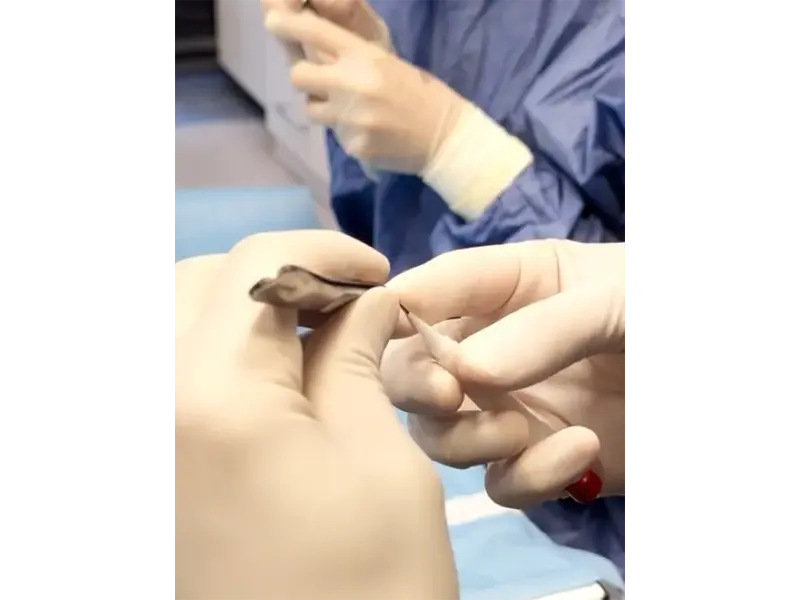
In FUE, small channels have to be opened in the recipient area for the grafts to sit in. The blade that does this determines the shape of the opening, and that has practical consequences.
A metal blade makes an opening with a U-shaped cross-section. A blade made of sapphire, single-crystal corundum, harder than steel, holds a sharper, thinner edge and produces a V-shaped cross-section. At the same width, less tissue is pushed aside.
- Density. Smaller openings can sit closer together. The target of 45–55 grafts/cm² is reachable with less load on the tissue.
- Angle and direction. A stable, sharp point allows work at a very flat angle in the hairline. That is what decides whether the result reads as natural.
- Recovery. The smaller the incision, the shorter the period in which crusts and redness are visible.
Process
How the operation runs
-
01Before you travel
Photo assessment
Four photographs, top, front, side, back, and your basic medical history. You receive the plan and an itemised written quotation before anything is booked.
-
02Day 1
Examination and design
Blood tests. The hairline is drawn against your facial proportions and age, and the graft distribution is decided. Nothing proceeds without your agreement to the drawing.
-
03Day 2 · morning
Extraction
Grafts are taken one by one with a 0.6–0.8 mm micropunch, sorted under magnification and held in cooled storage solution.
-
04Day 2 · midday
Opening the channels
The sapphire blade makes the openings: angle, direction and depth are fixed here. A particularly flat angle is used in the hairline.
-
05Day 2 · afternoon
Placement
Grafts are placed one at a time. Single-hair grafts at the front, multi-hair grafts behind them. That is how density is reached without a hard-looking edge.
-
06Day 3
First wash and departure
The first wash is demonstrated, you are given the aftercare products and written instructions, then the transfer to the airport.
Free assessment
How much donor capacity do you have?
Send four photographs and you will receive your donor capacity, an estimated graft count, the technique that suits you and an itemised written quotation. There is no charge and no obligation.

Free pre-analysis
Start your personal assessment
Leave your number and our coordination desk will call you back, usually the same day.
Suitability
When Sapphire FUE is the better choice
Suits
- A large continuous area that has to be covered in one session
- A donor area dense enough to supply the grafts required
- No objection to close shaving, or you wear your hair short anyway
- Rebuilding an area where little native hair remains
Suits less well
- You do not want your hair shaved, DHI comes into view instead
- Densifying only between hair you still have; opening channels can catch existing hair
- The donor area has itself thinned diffusely
- Loss is progressing quickly and the cause has not been established
For densifying between existing hair and for working without shaving, DHI is usually the technique indicated. Which of the two applies to you is decided by our surgeon after your donor area has been examined.
Recovery
Recovery and result
| Period | What happens |
|---|---|
| Days 1–3 | Swelling and redness. The first wash is done with you before you fly home. |
| Days 4–10 | Crusts form and come away with the prescribed washing routine. Do not pick them off. |
| Weeks 2–8 | The transplanted hairs shed. This is expected. The follicle stays; the shaft is what falls out. |
| Months 3–4 | New growth starts, fine and uneven at first. |
| Months 6–9 | Density builds and the result starts to read as yours. |
| Months 12–18 | The final result. Judging it before month twelve is judging it too early. |
What this procedure does not do
It moves hair; it does not stop hair loss. The follicles taken from the back and sides keep their resistance to pattern loss after they are moved, which is why the transplanted hair stays. Your native hair elsewhere continues to behave as it would have done. That is why a plan drawn against loss that is still progressing quickly, with no cause established, produces a result that looks wrong in a few years.
What a package costs and what is inside it is on the cost page. Short answers to the most common questions are on the FAQ page.
Frequently asked questions
What is the difference between Sapphire FUE and standard FUE?
The extraction is the same. Follicles taken one by one with a 0.6–0.8 mm micropunch. The difference is the blade that opens the channels in the recipient area. A sapphire blade holds a sharper edge and makes a V-shaped rather than U-shaped opening, so less tissue is displaced at the same width.
Will there be a scar?
Not a linear one. No strip of scalp is cut, so what remains in the donor area is dot-shaped marks of 0.6–0.8 mm, concealed by the surrounding hair once it has grown back. FUT, which does leave a linear scar, is not a technique we coordinate.
How many grafts can be done in one session?
Typically 2,000–4,500, depending on your donor capacity and the area to be covered. The number for your case comes out of the assessment; a figure quoted without examining the donor area is an estimate rather than a commitment.
Do I have to shave my head?
For Sapphire FUE, normally yes. If avoiding a shave matters to you, ask about DHI at the assessment. Whether an unshaven session is realistic depends on your graft count and is a clinical judgement.
Does it hurt?
The procedure is done under local anaesthetic. What people report as uncomfortable is the anaesthetic injection itself rather than the six to eight hours that follow.
When can I go back to work?
Desk work in 2–3 days. Anything involving sweating, direct sun or a helmet waits longer; the written aftercare you are given on day three has the dates.
Will the transplanted hair fall out?
The shafts shed between weeks 2 and 8. That is expected and is not a failure, the follicle stays. New growth starts around months 3–4, density builds through months 6–9, and the final result is at 12–18 months.
Will I need a second session?
Sometimes. It depends on the area and on your donor capacity, which is finite and spent once. Where a plan is realistically two sessions, saying so at the start is more honest than discovering it afterwards.
Free pre-analysis
Start your personal assessment
Leave your number and our coordination desk will call you back, usually the same day.
- Our own Ministry-licensed clinics
- Authorisation certificate AK-0604, verifiable
- Clinic named in writing before you travel
- Sapphire FUE and DHI techniques
- Airport pickup, hotel and transfers
- Follow-up at months 1, 3, 6 and 12
Your enquiry is handled by our coordination desk, in your own language.