






TREATMENT
Hair Transplant
In shortA hair transplant moves your own hair follicles from the back and sides of the scalp, where hair is genetically resistant to loss, into thinning or bald areas. The two techniques used today are Sapphire FUE and DHI. A session takes 6–8 hours, and the final result is visible 12–18 months later.
Key facts
- Techniques
- Sapphire FUE · DHI
- Session length
- 6–8 hours, single day
- Typical grafts
- 2,000–4,500 per session
- Target density
- 45–55 grafts/cm²
- Punch diameter
- 0.6 – 0.8 mm
- Back to desk work
- 2–3 days
- Shedding phase
- Weeks 2–8 (normal)
- Final result
- 12–18 months
- Stay in Istanbul
- 3 nights
Hair transplant
What is a hair transplant?
Hair transplantation is the surgical relocation of hair follicles from a donor area to a recipient area on the same person. It is an autograft: the hair is your own, so there is no rejection risk and no matching problem.
The procedure works because of a property called donor dominance. Follicles on the back and sides of the scalp are not sensitive to dihydrotestosterone (DHT), the hormone responsible for androgenetic alopecia. When those follicles are moved to a bald area, they keep that resistance and continue to grow for decades.
This also sets the honest limit of the operation: a transplant redistributes the hair you have. It does not create new hair. Everything depends on how much usable donor hair you own. Which is why the donor assessment matters more than any brochure.
Advantages and limitations
A balanced view is more useful than a sales pitch, so both sides are listed here.
What it does well
- Uses your own hair. No rejection, no lifelong medication for the transplanted hair
- Permanent: transplanted follicles keep their DHT resistance
- A single treatment rather than a recurring monthly cost
- Grows, greys and can be cut like the rest of your hair
- Density and hairline shape are designed, not left to chance
What it cannot do
- Limited by donor capacity. A very advanced loss cannot be fully covered
- Does not stop ongoing loss in untreated native hair; that needs separate medical management
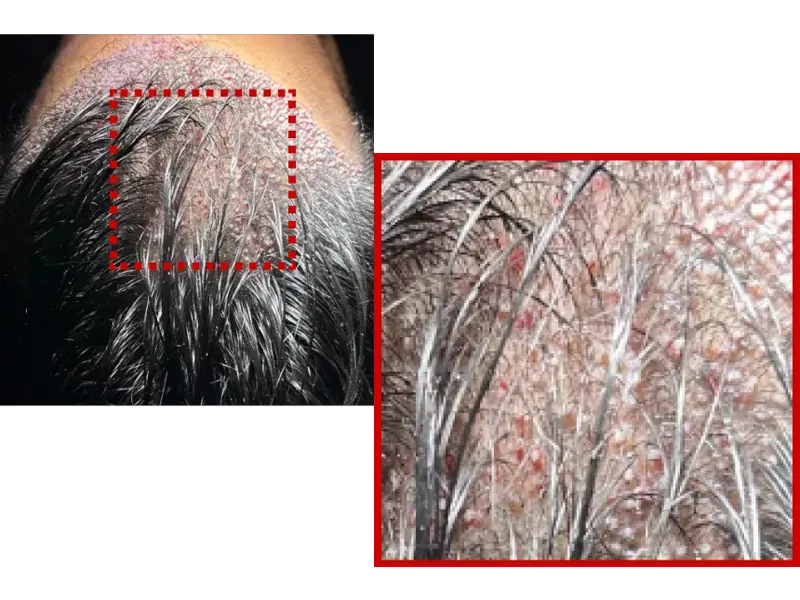
- Visibly recovering for roughly 10–14 days (redness, crusting)
- Transplanted hair sheds at weeks 2–8 before regrowing, an unnerving but normal phase
- Result quality depends heavily on the operating team’s hand, not on the brand of the device
Operation type
Sapphire FUE or DHI, which technique?
Both techniques extract grafts the same way, one by one, with a micro punch of 0.6–0.8 mm. They differ in how the graft is placed. The older strip method (FUT), which removes a band of scalp and leaves a linear scar, is not used.
Sapphire FUE
Channels are opened first, with blades ground from synthetic sapphire rather than steel. The sapphire edge is sharper and holds that edge across thousands of incisions, so the channel is narrower and more uniform. Grafts are then placed into the prepared channels. Because channel-opening is a separate, deliberate step, the surgeon has fine control over the angle, direction and depth across the whole recipient area. Which is what makes a wide, even coverage look natural.
DHI (Direct Hair Implantation)
A Choi implanter pen opens the channel and places the graft in a single movement. The graft spends less time outside the body, and because no pre-made channel is needed, grafts can be placed between existing hairs without damaging them. This makes DHI the stronger choice for the frontal hairline and for adding density to an area that still has native hair.
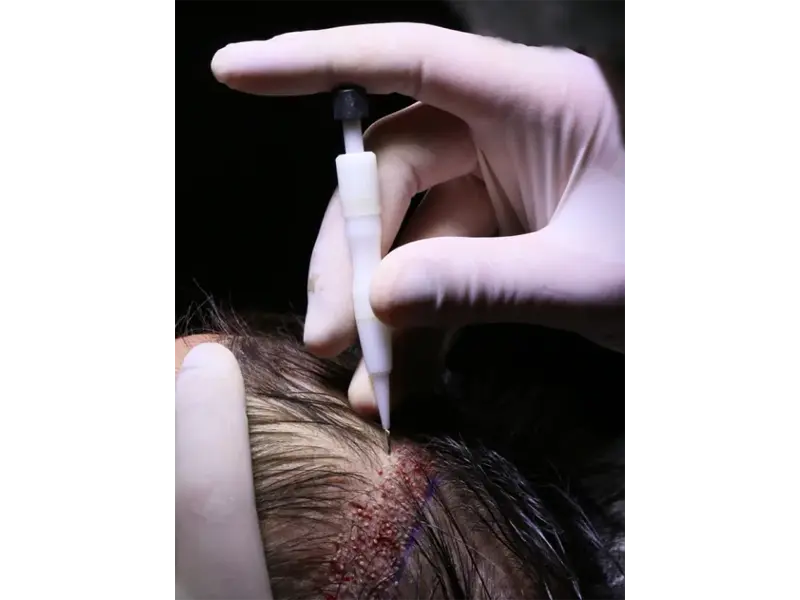
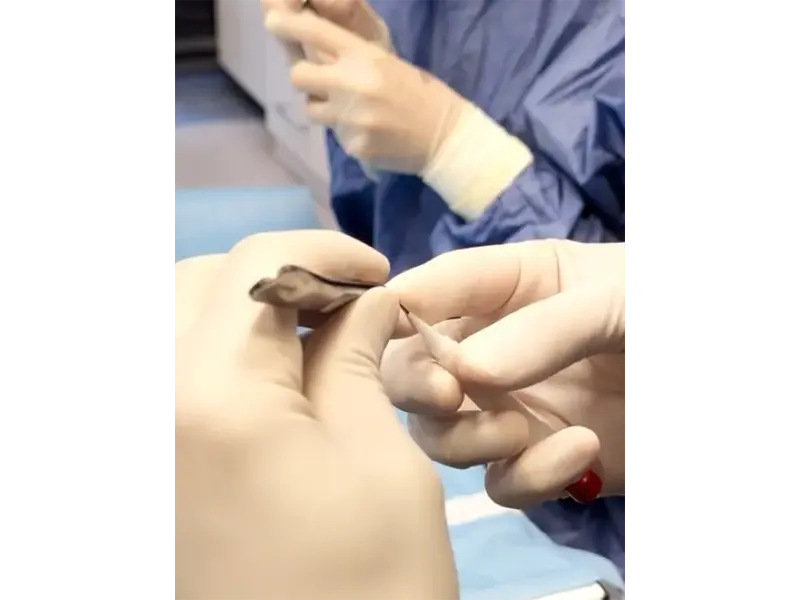
Left: a graft being placed at the hairline with a Choi implanter pen. Right: grafts being separated and held in solution under sterile conditions before placement.
| Sapphire FUE | DHI | |
|---|---|---|
| Extraction | Micro punch, 0.6–0.8 mm | Micro punch, 0.6–0.8 mm |
| Channel opening | Separate step, sapphire blade | Same step as placement |
| Placement | Into pre-opened channels | Choi implanter pen |
| Graft time outside body | Longer | Shorter |
| Channel shape | Narrow, uniform slit | Round, needle-formed |
| Grafts per session | Higher, suits large areas | Lower, slower per graft |
| Best suited to | Crown and wide coverage | Hairline and density between existing hair |
| Shaving | Full shave usually needed | Can often be done unshaven |
Process
What happens, step by step
From first contact to the final check-up, the process runs over roughly 12–18 months, of which only three days are spent in Istanbul.
-
01Before travel
Assessment
You send photographs from the top, front, side and back. Donor capacity, loss pattern and an estimated graft count are established, and the physician of the contracted health institution confirms whether you are a suitable candidate.
-
02Day 1
Arrival and planning
Airport transfer and hotel check-in. Blood tests are taken. The hairline is drawn on your own head according to your facial proportions and your age, and nothing proceeds until you approve the drawing in the mirror.
-
03Day 2 · morning
Extraction
Grafts are harvested one by one from the donor area with a micro punch, then sorted and kept in a cooled holding solution. Harvesting is deliberately spread across the donor zone so it does not thin visibly in one patch.
-
04Day 2 · afternoon
Placement
Grafts are placed following the natural exit angle and direction of the surrounding hair. Single-hair grafts go at the front edge for a soft hairline; three- and four-hair grafts go behind them to build density.
-
05Day 3
First wash and discharge
The first wash is demonstrated so you can repeat it correctly at home, aftercare products and written instructions are handed over, and you are transferred back to the airport.
-
06Months 1–18
Follow-up
Check-ins at months 1, 3, 6 and 12 in your own language. Transplanted hair sheds around weeks 2–8, starts to regrow from month 3, and reaches its final density at 12–18 months.
Suitability
Who is a good candidate?
Not everyone who wants a transplant should have one, and a clinic that tells you otherwise is not being straight with you. The assessment exists to answer this honestly.
Usually suitable
- Stable hair loss, typically from the mid-twenties onward
- Sufficient density in the donor area at the back and sides
- Androgenetic alopecia. The pattern loss that accounts for most cases
- Loss from scarring, burns or a previous surgery in a defined area
- Realistic expectations about coverage and timeline
Usually asked to wait or reconsider
- Very rapid, still-active loss in the early twenties, the pattern has not settled
- Insufficient donor density for the area needing coverage
- Untreated alopecia areata or an active scalp condition
- Uncontrolled diabetes or a bleeding disorder, until managed
- Expecting a teenage hairline at fifty. The design has to suit the face you have now
Age itself is rarely the deciding factor. There is no upper limit as long as general health allows it; the lower limit is about stability, not birthdays. If your loss is still moving quickly, transplanting into it means chasing a receding line and needing a second operation sooner than you should.
Reason
Why so many people travel to Turkey for this
Turkey performs more hair transplants than any other country, and the reasons are structural rather than promotional.
Volume produces skill
Hair transplantation is a manual craft. The angle of every channel and the handling of every graft are decided by a human hand thousands of times in one day. Teams in Istanbul run these operations continuously, and that repetition shows in the work. This is the same reason a high-volume surgical centre outperforms an occasional one in any field.
A regulated medical-tourism framework
International health tourism in Turkey operates under a licensing regime run by the Ministry of Health. Clinics and the health institutions they work with are authorised and audited. Asking to see the authorisation certificate is a reasonable question, and any legitimate organisation will show you theirs.
Cost, and why it is lower
The price difference against Western Europe or North America is large, and it is not explained by cutting corners. Staffing, facility and living costs are lower in absolute terms, exchange rates favour the incoming patient, and the sheer number of procedures spreads fixed costs thinly. What you should compare is what is included, grafts, technique, accommodation, transfers, interpreter, aftercare and follow-up, because a headline figure without that list is not comparable to anything.
The honest downside of medical travel
- Quality varies widely. The same city holds excellent teams and clinics that should be avoided. The market’s size is a strength and a risk at the same time.
- Detail can be lost in translation. A hairline is a conversation about your face. If that conversation happens through a hurried interpreter, you may get a technically correct operation with the wrong design.
- Follow-up is at a distance. Recovery mostly happens after you fly home, so ask what follow-up actually looks like, in which language, and for how long.
- Beware of graft-count inflation. A quoted count that far exceeds what your donor area can supply is a sales tactic, not a plan.
Recovery
The recovery timeline
Recovery is predictable, and knowing the schedule in advance removes most of the anxiety. Particularly around the shedding phase, which alarms people who were not warned about it.
| When | What happens | What you do |
|---|---|---|
| Days 1–3 | Redness and swelling; small crusts form | Sleep semi-upright; first wash as demonstrated |
| Days 4–10 | Crusts loosen and fall away | Daily gentle washing; no scratching or picking |
| Days 10–14 | Recipient area looks close to normal | Most people return to social life |
| Weeks 2–8 | Transplanted hair sheds. Expected, not a failure | Nothing; the follicle stays in place |
| Months 3–5 | New growth begins, fine and sparse at first | Follow-up check at month 3 |
| Months 6–9 | Hair thickens and density becomes visible | Follow-up check at month 6 |
| Months 12–18 | Final density, texture and hairline settle | Final assessment at month 12 |
The first fortnight, practically
- No hats, helmets or anything that rubs the recipient area for 10 days
- No swimming pool, sea or sauna for one month
- No gym or heavy lifting for two weeks. Sweat and blood pressure both matter
- No direct sun on the scalp for one month; shade rather than sunscreen on the grafts
- No alcohol for one week and no smoking for as long as you can manage. Circulation drives graft survival
What is included
What the coordination covers
Assessment before you travel
Photograph review, donor capacity and estimated graft count, confirmed by the physician of the contracted institution.
Transfers and accommodation
Airport welcome, private transfers throughout, and three nights at a contracted hotel.
Coordination in your language
A coordinator who speaks your language accompanies you on the operation day and stays reachable afterwards.
Aftercare and follow-up
Aftercare products, written instructions, the first wash shown in person, and check-ins at months 1, 3, 6 and 12.
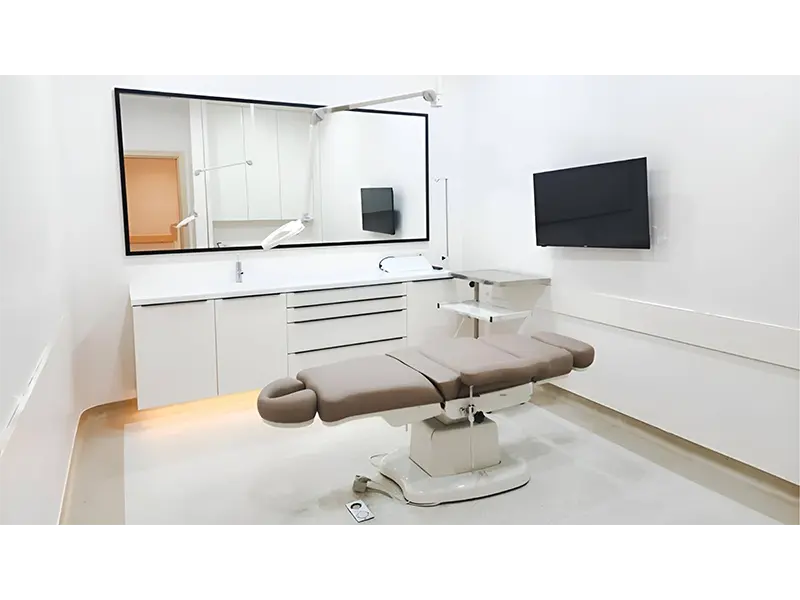

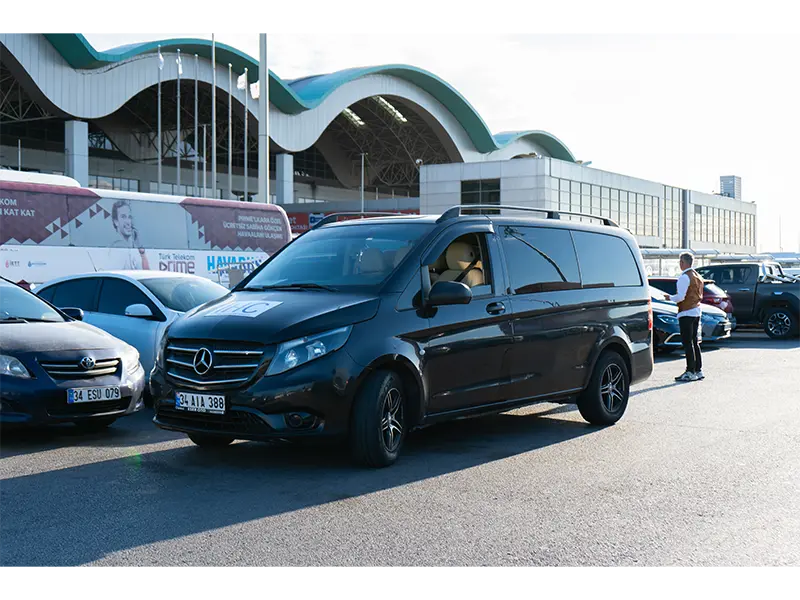
The contracted health institution’s operating room and reception, and the transfer service used between airport, hotel and institution.
Frequently asked questions
How long does a hair transplant take?
A single session runs 6–8 hours depending on the graft count, carried out in one day. You should plan three nights in Istanbul in total: arrival and planning, the operation, then the first wash and discharge.
How many grafts will I need?
Most sessions fall between 2,000 and 4,500 grafts. The number depends on the area to be covered and, more importantly, on what your donor area can supply without thinning visibly. A figure quoted before anyone has seen your donor area is a guess.
Will the result look natural?
Naturalness comes from the hairline design and the exit angle of each graft, not from the graft count. Single-hair grafts are placed along the front edge and multi-hair grafts behind them, following the direction your hair already grows. A hairline drawn to suit your age and facial proportions is what separates a good result from an obvious one.
Is the transplanted hair permanent?
Yes. Follicles taken from the back and sides keep their resistance to DHT after being moved, so they continue growing for decades. Your untransplanted native hair can still thin over time, which is why ongoing loss is managed separately.
When does the transplanted hair start to grow?
It sheds first, between weeks two and eight. This is expected and does not mean the graft has failed. Regrowth begins around month three, density becomes visible from month six, and the final result settles at 12–18 months.
Will I need a second session?
One session is enough for many people. A second is considered when the area is large, when donor capacity limited what could be done in one sitting, or when native hair continues to thin around the transplanted area. If a second session is likely, you should be told before the first one, not after.
Is there an age limit?
There is no upper limit as long as general health permits. The lower limit is about stability rather than age: if loss is still advancing quickly in the early twenties, transplanting into a moving pattern usually means a second operation sooner than necessary.
Can I have a transplant if I have had one before?
Often yes, provided the donor area still has capacity. Previous work changes the plan, existing grafts, scarring and the earlier hairline all have to be accounted for, so tell us the date and technique of the previous operation at the assessment stage.
Do I need to shave my head?
For Sapphire FUE over a large area, usually yes. DHI can often be performed unshaven or with only the donor area shaved, which is why it is frequently chosen by people who cannot take visible recovery time.
What does the price depend on?
On the graft count, the technique, and what is included in the package. Accommodation, transfers, interpreter, aftercare and follow-up. Compare the inclusions rather than the headline number; send your photographs and you will receive a specific figure rather than a range.
Free pre-analysis
Start your personal assessment
Leave your number and our coordination desk will call you back, usually the same day.
- Our own Ministry-licensed clinics
- Authorisation certificate AK-0604, verifiable
- Clinic named in writing before you travel
- Sapphire FUE and DHI techniques
- Airport pickup, hotel and transfers
- Follow-up at months 1, 3, 6 and 12
Your enquiry is handled by our coordination desk, in your own language.