







TREATMENT
Beard and Moustache Transplant
In shortBeard and moustache transplantation moves grafts from the back of your head into the beard area. Filling gaps, scars or a patchy line, or building a beard where growth has always been sparse. Mostly single-hair grafts, placed at a flat angle following the direction beard hair grows. A full beard can run to around 3,000 grafts.
Key facts
- Technique
- FUE
- Donor area
- Back of the head
- Punch diameter
- 0.6 – 0.8 mm
- Graft type
- Predominantly single-hair
- Graft count
- Up to around 3,000 for a full beard
- Minimum age
- 20
- Anaesthesia
- Local
- Shedding phase
- Weeks 2–8 (normal)
- Final result
- 12–18 months
- Carried out by
- Our surgeons, in our Istanbul clinics
The procedure
How a beard transplant works
The grafts come from the same donor area as a scalp transplant: the back of the head, where follicles are insensitive to the hormone that drives male pattern loss. They keep that property after they are moved, which is why the transplanted beard stays.
The difference from scalp work is in the placement. Beard hair grows almost flat against the skin and in directions that change across the face. Down the cheek, forward along the jaw, outward at the moustache. Each graft is placed to follow the direction of the area it sits in, and the angle is flatter than anywhere on the scalp.
- Predominantly single-hair grafts. Beard hair grows as individual hairs. A graft with several comes up as a cluster and reads as artificial however good the angle. Grafts are sorted under magnification for this reason.
- Density is built, not filled. A beard reads as full through the line at its edge and the consistency of direction, not through packing grafts as tightly as possible.
- The edge is designed. Where the beard line sits on the cheek and the neck is drawn and agreed with you before anything is taken.
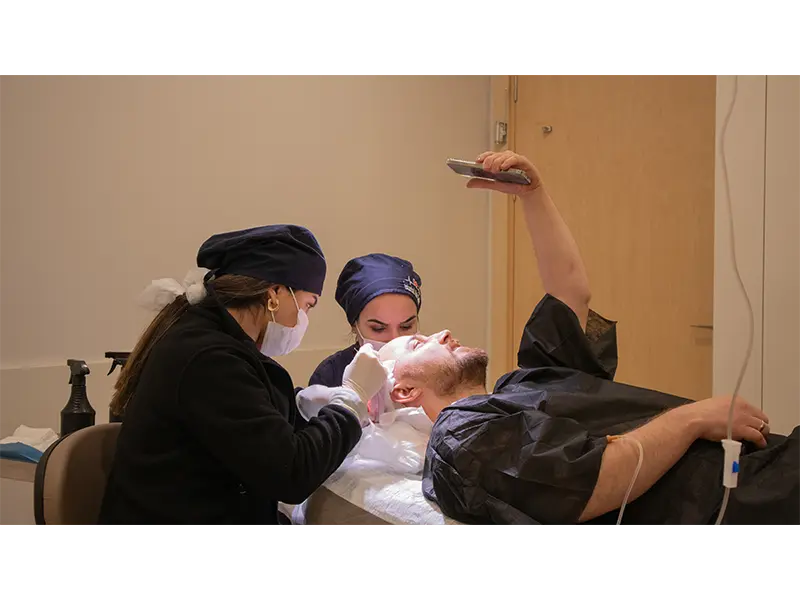
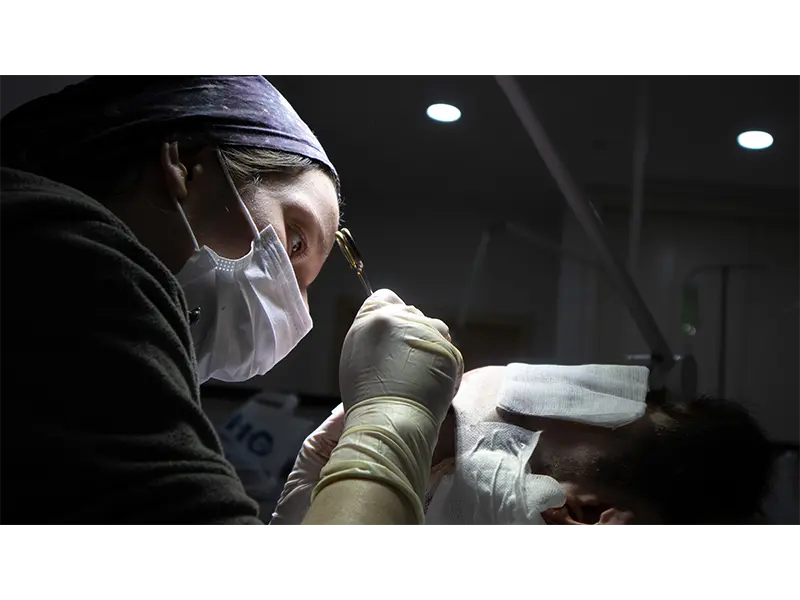
The operating environment at our clinic.
Suitability
Who this is for
Usually suitable
- Patchy growth or gaps that have not changed for years
- Scars and burn areas, once the tissue has settled
- Growth lost to poorly performed laser hair removal
- A beard line that has never filled in, from the age of twenty
Assess first
- Alopecia areata. Treat it first; a transplant is not the first answer
- Under twenty: hormonal balance and growth are not yet settled
- A donor area that is itself thinning
- Active skin disease in the beard area
Process
The three days
-
01Before you travel
Photo assessment
Photographs of the beard area from the front and both sides, and your basic medical history. You receive the plan and an itemised written quotation before anything is booked.
-
02Day 1
Examination and design
The tissue is assessed, the beard line is drawn on your face and agreed with you, and the graft distribution is decided. Nothing proceeds without your agreement.
-
03Day 2 · morning
Extraction
Grafts are taken one by one from the back of the head with a 0.6–0.8 mm punch and sorted under magnification into predominantly single-hair units.
-
04Day 2 · afternoon
Placement
Grafts are placed at a flat angle, following the direction of each part of the beard. Up to around 3,000 grafts for a full beard.
-
05Day 3
First wash and departure
The first wash is demonstrated, you are given written aftercare, then the transfer to the airport.
Free assessment
How many grafts would your beard need?
It depends on the area and on what is growing there now. A full beard can run to around 3,000 grafts, but the number for your case follows the assessment of your photographs. Send them and you will receive the plan, the estimate and an itemised written quotation.

Free pre-analysis
Start your personal assessment
Leave your number and our coordination desk will call you back, usually the same day.
Afterwards
Recovery, and the shaving question
| Period | What happens |
|---|---|
| Days 1–3 | Swelling and redness. The first wash is done with you before you fly home. |
| Days 4–10 | Crusts form and come away with the prescribed washing routine. Do not pick them off. |
| Weeks 2–8 | The transplanted hairs shed. This is expected. The follicle stays; the shaft is what falls out. |
| Months 3–4 | New growth starts, fine and uneven at first. |
| Months 6–9 | Density builds and the result starts to read as yours. |
| Months 12–18 | The final result. Judging it before month twelve is judging it too early. |
When can I shave again?
The date is in the written aftercare you are given on day three, and it is worth waiting for. Starting earlier on your own initiative is the most common way grafts that have not yet anchored are lost. Nothing about the result is improved by two weeks saved at the beginning.
The hair keeps growing like scalp hair
The grafts come from your scalp and keep its growth rate, so a transplanted beard needs trimming to the length you want it. That is inherent to the method rather than a complication.
Costs are on the cost page. Related: eyebrow transplantation and hair transplantation.
Frequently asked questions
At what age can a beard transplant be done?
From about twenty. Around that age hormonal balance settles and physical development is complete; before it, the growth pattern is not yet fixed.
How many grafts do I need?
It depends on the area and on what is growing there now. A full beard can run to around 3,000 grafts. The number for your case follows the assessment of your photographs. A figure given without one tells you nothing.
Can it be done on a scar or a burn?
Often, but the tissue there is assessed first and the plan is adjusted to it. Skipping that step is how grafts fail to take. Send a close-up with your photographs.
Where do the grafts come from?
The back of the head. The same donor area as a scalp transplant. Follicles there are insensitive to the hormone that drives male pattern loss and keep that property after they are moved.
Will the transplanted beard keep growing?
Yes. The hair keeps the properties of the place it came from and therefore grows at scalp speed. Trimming it to the length you want remains necessary.
When can I shave again?
The date is in the written aftercare given to you on day three. Starting earlier on your own initiative is the most common way grafts that have not yet anchored are lost.
My beard fell out from alopecia. Can I have this?
Treatment first. What responds to treatment should not be solved with an operation. If the result does not hold, a transplant comes into consideration then.
Why predominantly single-hair grafts?
Beard hair grows as individual hairs. A graft carrying several comes up as a cluster and reads as artificial even when the angle is correct, which is why grafts are sorted under magnification.
Free pre-analysis
Start your personal assessment
Leave your number and our coordination desk will call you back, usually the same day.
- Our own Ministry-licensed clinics
- Authorisation certificate AK-0604, verifiable
- Clinic named in writing before you travel
- Sapphire FUE and DHI techniques
- Airport pickup, hotel and transfers
- Follow-up at months 1, 3, 6 and 12
Your enquiry is handled by our coordination desk, in your own language.