



GUIDE
Hair Transplant Without Shaving
In shortAn unshaved hair transplant is possible, and it is usually done with DHI: because an implanter pen opens and fills each site in one movement, no channels have to be cut through hair you still have. It is not suitable for every case, the deciding factors are how many grafts you need and how long your existing hair is, and whether it applies to you is settled at the examination, not before.
Key facts
- Usual technique
- DHI (implanter pen)
- What gets shaved
- Often only the donor strip
- Realistic graft range
- Roughly up to 2,000–2,500
- Session length
- 6–8 hours, single day
- Stay in Istanbul
- 3 nights
- Final result
- 12–18 months
- Decided by
- Our surgeon, at the examination
The short answer
Can a hair transplant be done without shaving?
Yes, in a good number of cases, and no, not in all of them. Both halves of that sentence matter, because “unshaven transplant” is marketed as though it were simply a better option that some clinics offer and others do not. It is a technique choice with real trade-offs.
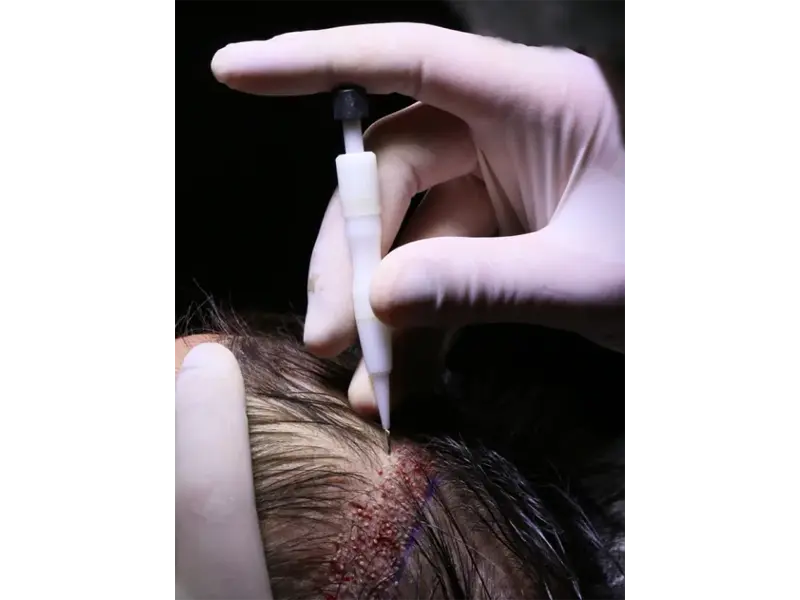
The reason it is possible at all comes down to how the grafts go back in. In Sapphire FUE, channels are opened first with a blade and the grafts are placed into them afterwards. Cutting those channels between hairs you still have risks catching them. In DHI, an implanter pen makes the opening and releases the graft in a single movement, so the operator places each graft exactly where there is room for it.
What is actually shaved
Unshaven, partially shaven, fully shaven
Three arrangements are in common use, and the words are used loosely enough that it is worth asking which one you are being quoted for.
| Arrangement | What is shaved | Typically suits |
|---|---|---|
| Fully unshaven | Nothing | Small graft counts; long hair you cannot cut |
| Partially shaven | A strip in the donor area, hidden by the hair above it | Most unshaven cases, the usual compromise |
| Fully shaven | The whole head | Large areas, high graft counts, maximum coverage |
The middle row is what most people actually get when they book an “unshaven” procedure: the donor strip at the back is trimmed and the hair above it covers the trimmed area completely, while the recipient area is untouched. From the front, nothing looks different the next day.
The trade-offs
What you give up, and what you gain
What unshaven buys you
- You can go back to work without an obvious change
- No waiting weeks for a shaved head to grow out
- Existing hair is not cut by channel opening
- The recipient area is not exposed while it heals
What it costs you
- A lower realistic graft count in one session
- A longer, slower session for the same number of grafts
- Harder to reach maximum density in a large bald area
- Longer hair makes the work harder, length is a real constraint
The honest summary: unshaven is a discretion decision, not a quality decision. It does not produce a better result, and it does not produce a worse one. It changes how many grafts are realistic in one sitting and how long the day takes.
Suitability
When it will not work for you
Four situations where an unshaven plan is likely to be turned down, and where a provider who agrees to it anyway is worth a second look:
- A large bald area needing maximum coverage. Above roughly 2,000–2,500 grafts, working around existing hair costs more time than the session has.
- Very long hair. The longer the hair, the harder it is to see and reach the scalp. Some plans need a trim even in an “unshaven” arrangement.
- A donor area that is itself thinning. If the donor is diffuse, harvesting without a clear view of it is not a good idea.
- Very dense existing hair in the recipient area. Sometimes there is genuinely no room to place grafts without cutting what is already there.
Free assessment
Whether it applies to you
Send four photographs, top, front, side, back, and say that avoiding a shave matters to you. You will receive your donor capacity, an estimated graft count, whether an unshaven plan is realistic at that count, and an itemised written quotation.
Free pre-analysis
Start your personal assessment
Leave your number and our coordination desk will call you back, usually the same day.
Afterwards
Recovery is the same either way
| Period | What happens |
|---|---|
| Days 1–3 | Swelling and redness. The first wash is done with you before you fly home. |
| Days 4–10 | Crusts form and come away with the prescribed washing routine. |
| Weeks 2–8 | The transplanted hairs shed. Expected, the follicle stays. |
| Months 3–4 | New growth starts, fine and uneven at first. |
| Months 6–9 | Density builds. |
| Months 12–18 | The final result. |
Note what unshaven does not change: the shedding phase still happens in weeks 2–8, growth still starts around months 3–4, and the final result is still at 12–18 months. What it changes is how visible the first two weeks are to other people.
Frequently asked questions
Can a hair transplant really be done without shaving?
Yes, in many cases. Usually with DHI, because an implanter pen opens and fills each site in one movement rather than cutting channels through hair you still have. In practice most “unshaven” procedures shave only a strip in the donor area, hidden by the hair above it.
How many grafts can be done unshaven?
Roughly up to 2,000–2,500 as a realistic guide. Above that, working around existing hair usually costs more time than a single session has. The number for your case is set at the examination.
Does an unshaven transplant give a worse result?
No, and it does not give a better one either. The target density, the session length and the 12–18 months to a final result are the same. What changes is how many grafts are realistic in one sitting.
Is unshaven more expensive?
Our packages run €2,000 – €3,000 and are priced per package rather than per graft. What sits inside each package is on the cost page; the exact figure follows the photo assessment.
Will people notice?
That is the point of the arrangement. With the recipient area untouched and only a hidden donor strip trimmed, most people go back to work without an obvious change. Though redness and small crusts are visible up close for the first week or so.
Does my hair need to be a certain length?
Long hair helps hide the donor area but makes the work harder, and very long hair can make an unshaven plan impractical. Mention your current length when you send photographs.
Is DHI the only unshaven technique?
It is the one that makes it practical, because no channels are cut in advance. DHI itself can also be done on a shaved head, the two choices are separate.
Who decides whether I can have it unshaven?
The physician of our clinic, after seeing your donor area and the recipient area. A web page cannot settle it, and neither can a photograph on its own.
Related pages
Free pre-analysis
Start your personal assessment
Leave your number and our coordination desk will call you back, usually the same day.
- Our own Ministry-licensed clinics
- Authorisation certificate AK-0604, verifiable
- Clinic named in writing before you travel
- Sapphire FUE and DHI techniques
- Airport pickup, hotel and transfers
- Follow-up at months 1, 3, 6 and 12
Your enquiry is handled by our coordination desk, in your own language.